
Located deep in B.C.’s southern interior is a true ecological treasure – the inland temperate rainforest. This ecosystem is a home to ancient cedar trees, endangered wildlife, and species still unknown to science. Yet despite its ecological significance, parts of this rainforest remain open to logging. A recent piece in The Narwhal highlights the growing urgency among scientists and conservationists to protect three untouched valleys part this rare B.C. landscape: the Rainbow, Frisby, and Jordan.
The inland temperate rainforest supports extraordinary biodiversity. Researchers have documented wildlife, plants, and habitat for many at-risk species, including grizzly bears, wolverines, and the endangered deep-snow caribou. Some species discovered here have even been entirely new to science.
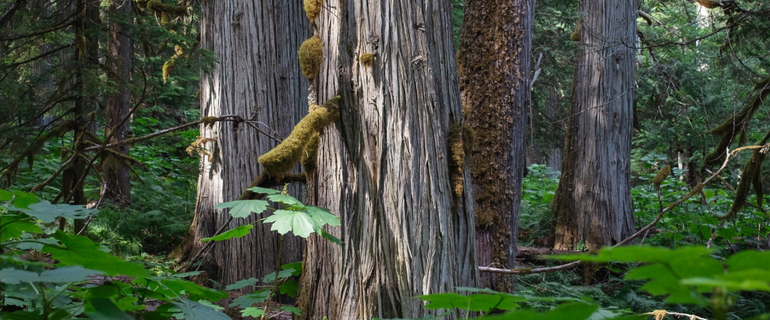
Scientist Toby Spribille, a leading lichen expert, describes these valleys as ecological “jewels.” While exploring the Rainbow Valley, Spribille has documented rare lichens and other organisms whose presence signals just how rare, critical, and healthy this ecosystem truly is. But what makes this ecosystem even more remarkable is its age and longevity. Thousand-year-old cedar trees are central to this complex habitat, sustaining life in ways younger forests are unable to. Not to mention, these valleys remain largely untouched and are connected from mountain peaks to valley floors. Maintaining this connectivity is critical to sustaining biodiversity and helps the ecosystems stay resilient in the face of climate change, maintaining cooler temperatures, deep snowpacks, and stable moisture levels.
Despite its richness, this rainforest is critically endangered. This article comes at a time when scientific reports continue to demonstrate how decades of logging, wildfires, and ineffective old-growth deferrals have left the province’s primary forests at risk, incredibly fragmented and vulnerable. In fact, less than five percent of its original old-growth forest remains. Decades of industrial logging have fragmented the landscape, leaving isolated patches that are often too small to support sensitive species.
One of the clearest warning signs has been the documented decline of the deep-snow caribou, with some herds recorded now being made of just a handful of individuals. Scientists describe the caribou as a “canary in the coal mine,” signaling the breadth of ecosystem collapse. These animals depend on old-growth forests for food and shelter, particularly the lichens they eat during winter. When their habitat disappears, so do they.
Although logging is not currently underway in the three valleys, forestry companies hold licences to operate there. In response, conservation groups have proposed creating a provincial park to permanently protect over 10,000 hectares of the intact rainforest. The proposal has gained support from local governments and Indigenous groups, who recognize the landscape’s ecological and cultural significance. While temporary logging deferrals are in place, the province has yet to commit to formal protection.
Ancient forests around the world continue to be reduced to small, degraded fragments, but B.C. still has a chance to choose a different path. Spribille’s findings makes it clear that there is no justification for logging these forests. Not only are they beautiful, but they hold significant scientific, ecological, and cultural value that far outweighs any potential short-term economic gain. The conservation of these valleys would mean the preservation of a rich, rare, and connected rainforest, safeguarding an ecosystem thousands of years old, and protecting Canada’s biodiversity at a time when species continue to disappear at unprecedented rates.
The fate of these valleys ultimately comes down to political will and action. Temporary protections and delayed decisions reflect a dominating challenge in climate governance – the balancing of short-term economic interests with long-term environmental responsibility. If governments are serious about climate and biodiversity commitments, those promises must translate into action. Protecting the inland temperate rainforest would represent a clear shift in recognizing that conservation is not optional but is foundational to a climate resilient and sustainable future.
- Log in to post comments
CRC Comments